





Why Handyman Businesses Need a Professional Website
Handyman businesses solve problems that customers often need addressed quickly.
A damaged door, broken fixture, leaking tap, damaged wall, loose cabinet, unfinished repair, furniture assembly project, painting job, maintenance requirement, or home improvement task can quickly become a priority for a homeowner, landlord, property manager, office, or business.
Yet being able to perform the work is only one part of running a successful handyman business.
The other challenge is getting discovered by people who need those services.
Modern customers increasingly turn to the internet when looking for service providers. They search for handyman services, compare companies, examine reviews, browse service offerings, look at previous work, and decide which businesses appear trustworthy.
This makes a professional handyman website a valuable business asset.
A website can become much more than a digital brochure. When properly planned and developed, it can function as a lead-generation engine, service catalogue, credibility platform, booking channel, customer education hub, and long-term SEO asset.
For a handyman business seeking to move beyond depending entirely on referrals and social media, a professional website can provide a stronger foundation for sustainable growth.
This is where Butterfly Prime Solutions can make a difference.
By combining strategic web design, responsive development, conversion-focused layouts, compelling content, and SEO-ready architecture, Butterfly Prime Solutions can help handyman businesses create a digital presence designed around their customers and business objectives.
Understanding the Industry Challenge
Handyman businesses have a unique advantage: they can often solve a wide range of practical problems.
However, that versatility can also create a marketing challenge.
Handyman Services Can Be Broad
A handyman may offer services including:
- General home repairs
- Furniture assembly
- Painting
- Drywall repairs
- Carpentry
- Door repairs
- Cabinet installation
- Shelving installation
- Fixture installation
- Property maintenance
- Minor plumbing work
- Minor electrical-related services where appropriately qualified
- Renovation assistance
- Commercial maintenance
- Rental property maintenance
- General building repairs
The problem is that potential customers may not know everything a handyman business offers.
A website gives the company an opportunity to organize these services into clear categories.
Customers Want to Know What They Are Getting
Before hiring a handyman, customers may want answers to questions such as:
- What services do you provide?
- What types of projects do you handle?
- Do you work on residential properties?
- Do you serve commercial clients?
- Can I request an estimate?
- Can I schedule a service?
- Do you have experience with projects like mine?
- Can I see examples of previous work?
- How can I contact you?
A professional website can answer these questions before a potential customer ever makes a call.
Competition Is Not Limited to Other Handymen
Handyman businesses can compete for customers against specialized contractors, maintenance companies, renovation providers, independent tradespeople, and larger home-service companies.
A professional website provides an opportunity to communicate the handyman business’s specific value proposition.
Referrals Alone May Not Be Enough
Word-of-mouth recommendations can generate excellent business.
However, referrals increasingly lead to online research.
A potential customer may receive a recommendation and immediately search for the company.
If the business has a professional website, that search can reinforce the recommendation.
If there is no website, the customer may encounter competitors instead.
Why a Professional Website Matters for Handyman Businesses
1. It Gives the Business a Professional Digital Home
Social media pages and directory listings can be useful, but they should not necessarily be the entire digital presence of a handyman business.
A professional website gives the company its own online destination.
It becomes the central location for:
- Services
- Contact details
- Reviews
- Project photos
- Company information
- FAQs
- Booking
- Quote requests
- Helpful articles
The business gains greater control over how customers experience its brand.
2. It Makes a Broad Service Offering Easier to Understand
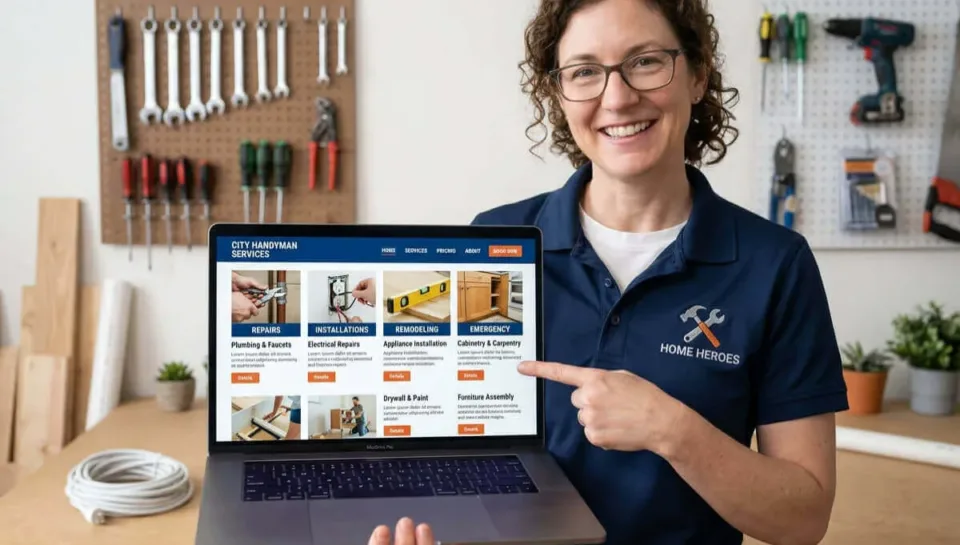
One of the biggest advantages of a professionally designed handyman services website is organization.
Rather than placing every service into one overwhelming paragraph, services can be grouped into logical categories.
For example:
Home Repairs
A dedicated section can explain common repair services and the types of issues the business handles.
Carpentry & Woodwork
Customers looking for shelving, trim, doors, cabinets, or other carpentry-related assistance can quickly find relevant information.
Painting & Finishing
The website can explain interior and exterior painting-related services where offered.
Furniture Assembly
Visitors can understand what types of furniture assembly and installation services are available.
Property Maintenance
Property owners and managers can learn about recurring maintenance solutions.
This structure improves usability while creating additional opportunities for SEO.
3. It Builds Trust Before the First Appointment
Hiring someone to work inside a home, office, rental property, or commercial space requires trust.
A website can help establish that trust by showcasing:
- Experience
- Services
- Professional photographs
- Customer testimonials
- Completed projects
- Company information
- Work processes
- Clear communication
- Service guarantees where applicable
A professional presentation can make the business feel established and dependable.
4. It Helps Customers Discover the Business Through Search
A website creates a foundation for handyman SEO.
Potential customers may search for individual services rather than the word “handyman.”
For example, someone may search for:
- Furniture assembly service
- Door repair service
- Home maintenance company
- Wall repair service
- Property maintenance handyman
- Cabinet installation service
- General home repair service
A strategically optimized website can target a broader collection of relevant searches.
5. It Converts Website Visitors Into Enquiries
Website traffic is valuable, but traffic alone does not pay the bills.
A professional handyman business website should be designed to encourage action.
Visitors should be able to:
- Request a quote
- Book a service
- Call the business
- Send a message
- Submit project details
- Ask a question
The website should make the next step obvious.
Benefits of a Professional Website for Handyman Businesses
More Qualified Leads
A visitor who has already explored the business’s services is more likely to understand what the company offers.
This can produce more relevant enquiries.
Stronger Brand Recognition
A distinctive website gives the handyman business an opportunity to develop a recognizable visual identity.
Branding can be reflected through:
- Logo
- Typography
- Photography
- Colors
- Messaging
- Service presentation
- Calls to action
This helps the business look more established.
Better Customer Experience
Customers should not have to work hard to find information.
A well-structured website can provide answers quickly and make contacting the business simple.
Increased Credibility
Professional design can communicate attention to detail.
For a handyman business whose work depends on precision and workmanship, that digital impression matters.
More Marketing Opportunities
A website can support multiple marketing strategies simultaneously.
It can receive traffic from:
- Search engines
- Social media
- Email campaigns
- Digital advertising
- Referral links
- Business directories
- Content marketing
This makes the website an important central component of the broader marketing strategy.
Ability to Showcase Real Work
Handyman services are highly visual.
Before-and-after photographs, renovation images, repair projects, installation work, and finished spaces can demonstrate the quality of the company’s work more effectively than generic claims.
Easier Quote Collection
Instead of receiving vague enquiries, a website can collect project information through structured forms.
Customers can explain:
- What needs to be repaired
- What service they require
- Property type
- Project scope
- Preferred schedule
- Additional requirements
This can make conversations more productive.
Essential Website Features for Handyman Businesses
A Conversion-Focused Homepage
The homepage should immediately answer three questions:
- What do you do?
- Who do you help?
- How can customers get started?
Strong messaging combined with clear calls to action can guide visitors toward contacting the business.
Dedicated Service Pages
A handyman business should consider creating individual pages for its most important services.
Possible pages include:
- Home Repairs
- Property Maintenance
- Carpentry
- Furniture Assembly
- Painting
- Door Repairs
- Cabinet Installation
- Shelving Installation
- General Maintenance
- Commercial Maintenance
Dedicated pages make the website easier to navigate and give search engines more content to understand.
Project Gallery
A visual portfolio can become one of the strongest elements of a handyman website.
Showcase projects through:
- Before-and-after images
- Repair photographs
- Installation photographs
- Renovation images
- Finished project images
Each project can tell a story about the problem, the work performed, and the result.
Quote Request Form
A well-designed quote form can allow visitors to provide project details without immediately calling.
This is particularly useful for projects that require explanation.
Online Booking
Where appropriate, online appointment scheduling can allow customers to select available service times.
This can reduce back-and-forth communication.
Customer Testimonials
Testimonials can provide valuable social proof.
Instead of simply stating that the business provides quality work, customer feedback can demonstrate it.
Frequently Asked Questions
An FAQ section can answer common questions regarding:
- Services
- Estimates
- Appointments
- Project preparation
- Maintenance
- Service expectations
- Payment processes
- Project timelines
FAQs can also target long-tail search queries.
Mobile-Friendly Design
Customers may search for handyman services from their phones while standing in front of the problem they need solved.
The website should therefore provide an excellent mobile experience.
Click-to-Call
Phone contact should be simple on mobile devices.
A prominent call button can make it easier for customers to connect immediately.
Contact Forms
Not every customer wants to call.
Contact forms give visitors another convenient way to start a conversation.
SEO Strategy for Handyman Businesses
A professional website should be built with search visibility in mind from the beginning.
Target Commercial Search Terms
The SEO strategy should focus on keywords that reflect genuine customer needs.
Examples include:
- handyman services
- handyman company
- handyman contractor
- professional handyman
- home repair services
- property maintenance services
- general handyman services
- handyman service provider
- home improvement handyman
- residential handyman services
- commercial handyman services
These can be supplemented by highly specific service keywords.
Build Service-Based Content Clusters
Rather than publishing unrelated blog posts, the website can create content clusters around important service categories.
For example, a home repair cluster might include articles about common household repairs, maintenance checklists, repair warning signs, and when to hire a professional.
Each article can connect back to the relevant service page.
This creates a stronger internal SEO structure.
Use Long-Tail Keywords
Long-tail keywords can capture highly specific searches.
Examples include:
- handyman for furniture assembly
- professional home repair services
- handyman for property maintenance
- handyman for home improvement projects
- handyman for door repairs
- handyman for cabinet installation
- handyman maintenance services
These searches may have lower overall volume than broad terms but can demonstrate stronger intent.
Create Helpful Educational Content
A handyman business can establish topical authority by publishing useful information.
Potential blog topics include:
- How to Know When a Home Repair Needs Professional Attention
- Home Maintenance Tasks You Should Not Ignore
- Common Household Repairs That Become Bigger Problems
- What to Check Before Hiring a Handyman
- Handyman vs Specialized Contractor: What Is the Difference?
- How Regular Property Maintenance Saves Time and Money
- Essential Maintenance Checklist for Property Owners
This content can attract users before they are ready to make a hiring decision.
Optimize On-Page SEO
Important pages should have optimized:
- Meta titles
- Meta descriptions
- Headings
- URLs
- Image alt text
- Internal links
- Content
- Calls to action
Optimize for Mobile Search
Since many home-service searches happen on mobile devices, mobile usability should be treated as an essential SEO and conversion consideration.
Strengthen Internal Linking
A blog article about furniture assembly should link to the furniture assembly service page.
An article about property maintenance should link to the property maintenance page.
This creates connections between educational and commercial content.
Common Website Mistakes in Handyman Businesses
Mistake 1: Listing Too Many Services Without Structure
Being versatile is a strength, but an unorganized list of services can overwhelm visitors.
Services should be grouped logically.
Mistake 2: Using Generic Website Copy
Statements such as “We offer quality services at affordable prices” do little to distinguish a business.
Website copy should communicate specific value.
Mistake 3: Failing to Show Completed Work
A handyman business has a major visual advantage.
Ignoring project photography means losing an opportunity to demonstrate workmanship.
Mistake 4: Making Customers Call for Every Detail
Some customers prefer to research before contacting a business.
A website should answer common questions and provide useful information upfront.
Mistake 5: No Clear Quote Request Process
If customers cannot easily ask for an estimate, potential leads may disappear.
Mistake 6: Ignoring Search Engine Optimization
A website that is not optimized for search may struggle to reach potential customers organically.
Mistake 7: Poor Mobile Experience
Tiny buttons, difficult forms, slow pages, and awkward navigation can discourage mobile visitors.
Mistake 8: Weak Calls to Action
A visitor should never wonder what to do next.
Mistake 9: No Trust Signals
A handyman website without testimonials, project evidence, company information, or other credibility elements may struggle to convert visitors.
Mistake 10: Treating the Website as a One-Time Project
A website should evolve.
New services, projects, FAQs, articles, testimonials, and campaigns can continue strengthening its value.
How Butterfly Prime Solutions Can Help
Building a successful handyman website design requires more than creating attractive pages.
The website needs to connect the business’s services with the needs of its customers.
Butterfly Prime Solutions can help handyman businesses create that connection.
Strategic Website Planning
The website can be planned around:
- Core services
- Customer needs
- Business goals
- Lead-generation opportunities
- Content strategy
- SEO objectives
- Conversion pathways
This provides a clear structure before development begins.
Professional Handyman Web Design
Butterfly Prime Solutions can create a modern website that communicates professionalism while making services easy to explore.
The design can emphasize practical information, project imagery, clear navigation, and strong calls to action.
SEO-Friendly Development
The website can be structured to support ongoing organic search growth through:
- Search-friendly architecture
- Optimized pages
- Keyword-focused content
- Internal linking
- Mobile responsiveness
- Technical SEO foundations
- Content expansion opportunities
Lead Generation Functionality
The website can incorporate conversion tools such as:
- Quote request forms
- Contact forms
- Booking systems
- Click-to-call buttons
- Service enquiry forms
- Strategic calls to action
Content Development
Strong content can help the business explain its services and demonstrate its knowledge.
Instead of simply saying “we fix things,” the website can communicate the specific problems the business solves and the types of customers it serves.
Scalable Website Architecture
As the handyman business grows, the website can expand with it.
New services, articles, landing pages, FAQs, project galleries, and marketing campaigns can be incorporated over time.
Why Choose Butterfly Prime Solutions?
A handyman business needs a website that reflects the practical nature of its services while still presenting the company as professional, trustworthy, and capable.
Butterfly Prime Solutions focuses on building websites that support those objectives.
Professional Design
Create a polished digital presence that makes a strong first impression.
Industry-Focused Structure
Organize handyman services in a way that makes sense to customers.
SEO-Ready Architecture
Build a foundation for stronger search visibility and future content growth.
Conversion-Focused Experience
Make it easier for visitors to request quotes, book services, call, or enquire.
Mobile Responsiveness
Ensure customers can navigate the website effectively across different devices.
Growth-Oriented Development
Create a website capable of evolving alongside the business.
Frequently Asked Questions
1. Why does a handyman business need a professional website?
A professional website helps handyman businesses establish credibility, showcase services, attract search traffic, generate enquiries, display previous work, and give potential customers an easy way to get in touch.
2. What should a handyman website include?
A strong handyman website should include service pages, project galleries, testimonials, contact forms, quote requests, calls to action, FAQs, company information, mobile-responsive design, and SEO-friendly content.
3. Can a handyman website generate leads?
Yes. With strong calls to action, quote forms, booking functionality, service pages, and SEO, a website can become an important source of new customer enquiries.
4. What is handyman SEO?
Handyman SEO is the process of optimizing a handyman business website to improve its visibility for searches related to handyman services, home repairs, maintenance, installations, and other relevant services.
5. Should a handyman create separate pages for different services?
Yes. Dedicated service pages can make it easier for visitors to find exactly what they need while creating additional opportunities to rank for specific search terms.
6. Should a handyman website display previous projects?
Absolutely. Project photography provides visual evidence of the business’s capabilities and can help potential customers understand the quality of its work.
7. Can customers request quotes through a handyman website?
Yes. A website can include customized quote forms that allow potential customers to describe their project and submit relevant details.
8. Can a handyman business accept bookings online?
Yes. Online booking functionality can be integrated where it fits the company’s scheduling process.
9. Is blogging useful for handyman businesses?
Yes. Blog content can help answer customer questions, target long-tail keywords, increase organic visibility, demonstrate expertise, and create additional pathways into service pages.
10. How can a handyman compete online with larger home-service companies?
A professionally designed website can help a handyman communicate specialized services, showcase real projects, develop a recognizable brand, target relevant search terms, and create a more personalized customer experience.
11. Should a handyman website be mobile-friendly?
Definitely. Many potential customers search for home-service providers from smartphones. A responsive website ensures they can easily browse services, view projects, call the business, or submit enquiries.
12. How can a website help a handyman build trust?
A website can display testimonials, completed projects, service information, company details, professional photography, FAQs, and transparent customer processes—all of which can help establish confidence.